Key takeaways
- Apps is open to every team, in beta: an app's models, actions and Next.js pages live in one folder, and Inference Bureau stores the records, runs the code and serves the pages.
- We built it so the code around a model call runs where the model call does: under the same Directives, budgets and Logs, and on the same bill.
- Next on the roadmap: more integration partners, more platforms (we're exploring Astro), and development an agent can drive from plan to deploy.
- It's a beta, so things will change. The Beta badge on every Apps page sends a bug, an idea or a screenshot straight to us.
Last week we wrote that we were building hosted apps. Today Apps is open to every team, marked Beta. This post covers why we built it, what's in it now, what we're working on next, and why we'd like to hear from you while it's still taking shape.
Why we built Apps
Most AI features need more than a model call. Something has to receive the webhook, keep a little data, run the job at 3am, call the model and do something with the answer. For most teams that means a second platform: a host for the code, a database, a queue, a cron service and a secrets store. Each one has its own bill, and none of them follow the rules you've set for your model traffic.
We kept running into this with the teams we work with, many of them building for Shopify merchants. The model call was the easy part. Everything around it took most of the time and caused most of the surprises.
So Apps puts the whole app in one place:
- One folder. You describe the data as models, write the code that changes it as actions, and put pages in a Next.js app under
web/. If you've built on Gadget, the layout will look familiar. - Next to your models. A model call from an action is an ordinary request. It follows your team's Directives, counts against the same budgets and shows up in Logs with everything else.
- One bill. Apps has its own plans (Free, Pro and Scale), and they're charged to the same team balance as your inference. There's no separate infrastructure invoice.
- Development and production kept apart. Each environment has its own files, records, variables and logs. Production only changes through a deploy you can review and roll back.
What's in the beta
- Two platforms. Shopify apps come with the store's shop, products and collections synced into models you can query, plus an embedded admin page, a storefront block and app proxy routes. Web apps come with sign-up, sign-in and members-only pages.
- Records and actions. Models with search, vector fields and access control, and actions that run inside the app's own deployment.
- An assistant in the dashboard. It reads and changes the app's files and data. Schema changes, record writes and deletes wait for your approval, and you can keep or revert every file it touches.
- Tools for your own agents. Each environment has an MCP server, and the starter files include an AGENTS.md and skills that teach Claude Code, Codex or Cursor how an app is laid out.
- The
ib-appsCLI and SDK on npm, for syncing files, running tests against in-memory records, and deploying.
Getting started walks through a first app in a few minutes.
What beta means here
Beta isn't a disclaimer we added for the launch. It describes where Apps is:
- Things will change. The SDK is still 0.x. When a change means you need to update your code, the changelog will say so and explain how.
- Some rough edges are still there. We've built a handful of example apps on it (reviews, a wishlist, a quiz, a bundler), but your app will do things ours don't. That's the feedback we're after.
- Your feedback decides what comes next. The roadmap below is our current plan, and it will move based on what you tell us.
What's next
More integration partners
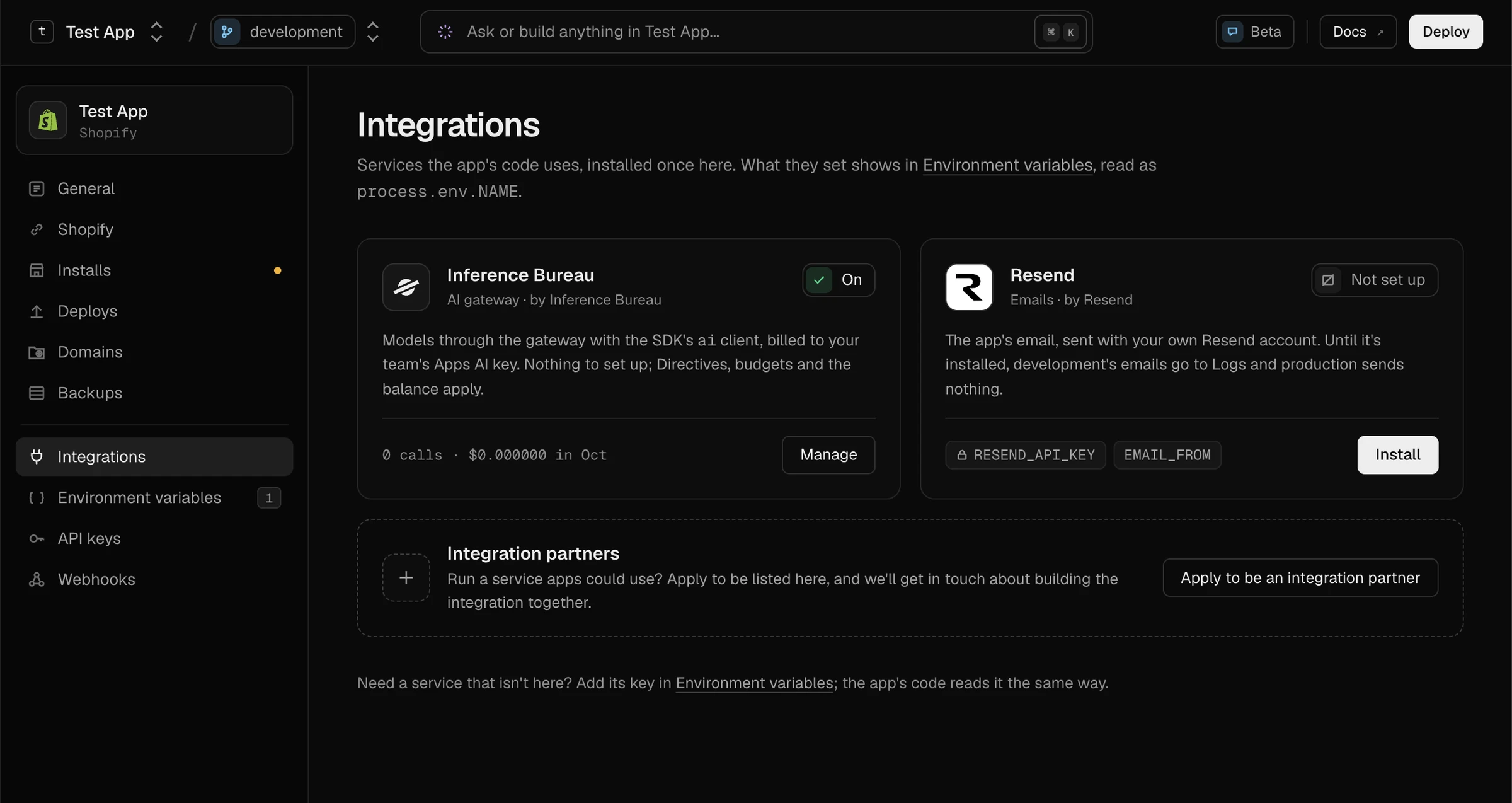
Today an app has two integrations: Inference Bureau itself, for models through the gateway with nothing to set up, and Resend, so the app sends email from your own account. An integration is set up once under Settings → Integrations, and the app's code reads it as ordinary environment variables.
We want many more of them: payments, storage, search, analytics and the services your apps already depend on. If you run one of those services, the Integrations page has an Apply to be an integration partner button, and we'll get in touch about building it together. If you use one and it's missing, tell us which through the Beta badge.
More platforms, starting with Astro
Pages are Next.js today. We're exploring Astro next, for content-heavy sites and storefront pages where shipping less JavaScript matters most. Models, actions, environments and Logs would work the same way. Only the web/ folder would change. This is still exploration, so we don't have a date yet. If you'd build on it, telling us what you'd build will help us decide.
Agent-driven development
Agents already build Apps with you. The dashboard assistant plans, edits files and checks its own work against the app's TypeScript and Shopify problems. Your own coding agent can do the same through the MCP server and the skills in the starter.
Where we want to go: you describe a change, and an agent takes it from plan to a tested deploy. It works in its own development environment, runs the app's tests, explains what it changed, and stops for your approval wherever it touches production or your data. The approvals, the keep-or-revert flow and the separate environments are the groundwork for that. We'll ship it one step at a time and write up each step as it lands.
Tell us what you think
We want to hear from you, especially this early:
- The Beta badge. The Apps list and every app's pages show a Beta badge next to the title. Click it to send a bug, an idea or general feedback, with screenshots if they help. It comes straight to us, along with the page and environment you were on.
- The roadmap. Suggest an idea on the roadmap, or vote for the ones you'd use. When we plan an idea you suggested, your team gets $10 in credit.
- Contact. For anything longer, a partnership or a call, use the contact page.
We read every message. The best way to shape Apps is to build something real on it and tell us where it got in your way.
Frequently asked questions
Is Apps ready for production?
Apps runs production apps today, with production kept apart from development and changed only by a deploy. It is in beta, so the SDK and some behaviour may change; changes you need to act on are announced in the changelog.
Does Apps cost anything during the beta?
Every team starts on Free, which includes one production app and five store installs. Pro and Scale add allowances and overage. The plans are charged to the same team balance as your models.
Will Astro replace Next.js?
No. Astro is being explored as a second option for an app's pages. Next.js stays supported.